The road shoulder of an expressway
Only for a vehicle that has broken down or been in an accident.
Penalty for driving on the expressway road shoulder
A composition fine and 6 demerit points.
Front wheels turned outward, 1st gear engaged, handbrake fully on.
A large vehicle signalling left swings out to the right
It is still turning left: slow down and let it turn. Do not pass it on the side it is turning into.
Keep at least a 3-second gap behind the vehicle in front, for all vehicles at any speed.
Countering centrifugal force
Reduce your speed before the bend.
A car has just parked at the roadside
Watch for doors opening, and pass with a gap of at least 1 metre.
Out-driving your headlights
Driving so fast that your stopping distance is longer than you can see. On high beam that is about 100 metres.
Picking up or dropping off passengers on an expressway
Blood Alcohol Concentration.
Brakes weak after driving through water
Pump the brake pedal repeatedly until they work again.
Narrow hill road: one vehicle going up, one coming down
The vehicle going uphill has priority.
A motorcyclist coming towards you on a bend
Keep further to your left: the rider may drift into your path.
How alcohol affects driving
Even a little alcohol impairs judgement, concentration, coordination and reaction time. If you drink, don't drive.
Passing pedestrians facing the traffic
Keep a gap of at least 1 metre.
A flooded road at night of unknown depth
Take another route: depth is hard to judge at night.
Road works on your side of a two-way road, with traffic coming
Give way to the oncoming vehicle before passing the works.
Why motorcyclists are at higher risk
They are small and fast, and hard to see, especially at night in dark clothes.
Passing a bus at a bus stop
Watch for pedestrians, especially children, dashing out from in front of the bus.
Dazzled by oncoming headlights
Slow down and look to your left, using the road edge as a guide. Stop if the light is blinding.
Slow down to keep control.
How often to check the rear-view mirror
Parked vehicles on your side of a two-way road
Give way to vehicles coming the other way.
A vehicle cuts into your lane dangerously
Slow down and give way to prevent an accident. Do not speed up.
An emergency vehicle behind you
As soon as you hear the siren or see its lights, move left (or right), slowing down or stopping if necessary.
What increases centrifugal force
Higher speed and a sharper bend: the harder it is to keep the vehicle in its lane.
Slower than in the daytime.
You miss your expressway exit
Carry on to the next exit.
Usually slow and heavy. Stay careful and alert in any traffic.
Following or stopping behind a large vehicle
Keep further back than usual, so you can see ahead and react if it stops suddenly.
Blood alcohol limit for driving
80 mg of alcohol per 100 ml of blood. Above that, you are presumed unable to drive properly.
Slow down by braking on and off, and keep a low speed until you are past the wet surface.
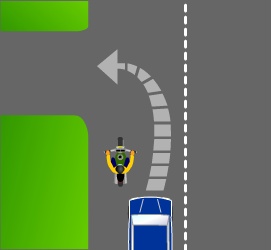
Turning left with a cyclist beside you
Slow down, follow behind the cyclist, and turn left when it is safe.
Vehicles not allowed on expressways
Bicycles, low trailers, learner drivers ('L' plates), mobile cranes, excavators and other construction vehicles.
Stopping for pedestrians to cross
Stop well before the stop line.
Gap when passing moving vehicles
Change down to 2nd or 1st gear before the climb: changing on the hill is difficult and you may roll back.
Give them plenty of room: their sight, hearing and reflexes may be weaker.
Lanes on a 3-lane expressway
Left lane for slower vehicles, centre lane for most traffic, right lane for overtaking.
Breaking down on an expressway
Hazard lights on, move onto the shoulder, keep everyone behind the guardrails, and put a warning triangle 20 m or more behind.
Keeping the driver behind informed
Give clear and correct signals in good time.
Why dip your headlights close behind another vehicle
Your beam reflects in its mirror and dazzles the driver.
Wear sunglasses or lower the sun visor.
The vehicle in front blocks your view of the road ahead.
Drive slowly so as not to splash them.
Speeding, sudden braking and bald tyres.
Centrifugal force greater than the tyres' grip
The vehicle loses control and skids.
Greater risk of side-slipping: use a lower gear, and avoid hard braking, hard acceleration and sharp steering.
The force that pushes a vehicle outwards on a bend, widening its turning path. It affects all vehicles.
Passing pedestrians with their backs to the traffic
Keep a gap of at least 1.5 metres.
Front wheels turned inward (towards the kerb), reverse gear engaged, handbrake fully on.
A cyclist wobbling with a heavy load or pillion
Slow down and leave a wider gap when passing.
Following distance going uphill
Keep a greater gap than on a level road.
Gap when passing fixed obstacles
Wheels lock and the car slides on a wet road
Release the brake pedal, then brake on and off until the car stops.
The right outermost expressway lane
Only for overtaking, without exceeding the speed limit; also for emergency vehicles. Move back when safe.
The tyres ride on a film of water and the vehicle glides, losing steering and braking. The faster you go, the worse it is.
Headlights and tail lights, to see and be seen.
A motorcyclist cuts in front of you on the expressway
Slow down if necessary to keep a safe distance from them.
High beam at a bend with poor visibility at night
It warns other road users that you are coming.
Following distance in rain or poor visibility
More than three seconds: braking is less effective and you see hazards later.
Pedestrian Crossing Ahead Markings (PCAMs)
They warn of a zebra crossing hidden from view.
Share of driving information that comes through the eyes
A ball bounces onto the road near parked cars
Slow down and be ready to stop: a child may run after it.
Approaching the top of a hill
Keep left and go carefully: you cannot see what is coming over the top.
People who cross the road anywhere, ignoring traffic rules.
Where to position your vehicle
Where you get a clear view of the vehicles around you.
Field of vision and speed
The slower you go, the wider your field of vision; it narrows as speed increases.
Avoiding a tailgating motorcyclist hitting you
Signal your intention to slow down early.
When to dip your headlights
When facing oncoming traffic and when following another vehicle, so as not to dazzle other drivers.
The brake lights of the vehicle in front come on
Slow down and watch what it does next.
They probably intend to change direction: be ready to slow down or stop.
Strong winds on an open highway
Slow down and drive with care: wind can push you into other traffic.
Reacting to traffic on an expressway
Earlier and faster, because traffic moves faster.
Feeling tired while driving
Stop safely at the roadside and rest.
What affects whether you are fit to drive
Your vision, physical health, mental state, and alcohol or drugs: drive only in good physical and mental condition.
In the zig-zag area before a zebra crossing
Do not park, overtake or speed up.
A vehicle slowing near a zebra crossing
Approach with care and be ready to stop: it may be stopping for pedestrians.
Driving through a passable flood
Signal on the slip road and build up speed to match the traffic, then merge smoothly.
A motorcyclist approaches as you are about to pull out
Let the motorcyclist pass first: they may not know you intend to pull out.
Zig-zag lines on the road
A zebra crossing is ahead.
Stay in your lane, calm and alert. Do not weave between lanes or sound your horn.
Take your foot off the accelerator and steer in the direction of the skid. Do not brake.
High, long and bulky; they need plenty of space to turn and travel at restricted speeds.
Tap the card to flip it. Use the arrow keys or swipe to move.
All flash card sets