The clutch is about half released and the engine revolutions drop slightly. Hold the clutch there ('half-clutch').
Engine stops when moving off
Too little accelerator, or the clutch released too suddenly.
Give way to traffic on your right.
Following a large vehicle towards traffic lights
Keep well back: you may not be able to see the lights, or stop if it stops.
Flashing amber traffic lights
The lights are out of order: slow down, watch for other vehicles and obey any police officer directing traffic.
Reversing into a side road on your left
Steer left first, then right.
Pedals in an emergency stop
Brake pedal first; clutch only when the car is almost stopped.
What cancels engine braking
Pressing the clutch pedal.
Overtaking several vehicles
Overtake only one vehicle at a time.
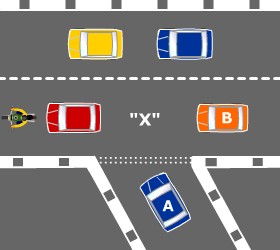
Heavy traffic: a vehicle waiting to join from a side road
Stop before the junction and let it merge in. It is courteous to let minor-road traffic join.
Position on a gradual bend
Stay in your lane, preferably in the centre.
Why use engine braking down a long slope
It saves the footbrake from overuse, so the brakes do not overheat and 'fade', and the car is less likely to skid.
The light turns amber when you are too close to stop safely
When to move back in after overtaking
When you can see the overtaken vehicle in your rear-view mirror.
Check your mirrors, signal and check the blind spot; adjust your speed and move across smoothly when it is safe.
Before going through a junction
Look left and right for other vehicles, even on a green light.
Releasing the clutch after changing gear
Gradually and smoothly. Releasing it suddenly makes the car jerk or the engine stall.
Press the clutch and release the accelerator, move the gear lever, then release the clutch while pressing the accelerator.
Green light, but the road beyond the junction is jammed
Wait before the junction until there is space to clear it.
Near a junction, sharp bend or pedestrian crossing, on a narrow bridge or steep slope, or when you cannot see far ahead.
Turning into a narrow bend too late
The front wheel gets obstructed.
Reversing very slowly in a manual car
Release and press the clutch repeatedly, with the accelerator slightly pressed.
Do not enter if you can see that your exit is blocked.
Where to look when changing gear
At the road ahead, not at the gear lever or pedals.
Turned into a dead end by mistake
Turn round in the side road and drive out forwards. Never reverse onto the main road.
Walk-round check before getting in
Look for body damage (including number plates and lights) and for under-inflated or punctured tyres.
Decide early which exit you need and get into the correct lane.
The engine stalls on an uphill slope
Brake at once so you do not roll back, apply the handbrake, shift to Neutral, then restart.
Before reversing into a parallel parking lot
Stop a little ahead of the lot, parallel to the kerb and 0.5 to 1 metre from it.
Holding half-clutch too long
The clutch lining wears out quickly from the heat of slipping.
Turning left into a minor road at a sharp angle
Slow down further rather than make a wide turn.
Turning right into a minor road
Get into the correct lane early and give way to oncoming vehicles.
Before a left turn into a narrow course
Position your vehicle more to the right: the rear wheels cut closer to the kerb.
Before starting the engine
Gear lever in Neutral (P in an automatic) and the handbrake applied.
Releasing the clutch too suddenly
The engine may stall or vibrate, and the vehicle may jump forward.
Gear for moving off uphill
Turning right from a lane shared with straight-ahead traffic
Signal early so the vehicles behind can move to another lane.
Engine vibrates violently when moving off
Too little accelerator, or the clutch released too far.
When to press the clutch while stopping
Just before the engine begins to vibrate.
Reversing round a corner: gap from the kerb
A narrow gap at the start becomes wider; a wide gap becomes narrower.
Turning into a narrow bend too early
The rear wheel gets obstructed.
Clutch pressed too late while stopping
Press the brake harder than usual, and apply the handbrake before releasing the brake pedal.
Being overtaken, even dangerously
Slow down gradually and make it easy to pass. Do not race; sound the horn only to warn of danger.
When you may move right of the centre line or keep-left position
When your path is blocked, for example by road works or parked vehicles, once it is safe.
Position for a sharp right-hand bend
Keep closer to the left, to see further round it. For a left-hand bend, keep near the centre line.
Driving forward out of a vertical lot to the left
Turn to full left lock when your body is level with the front bumper of the car on your left.
When to signal left at a roundabout
As you are about to leave it.
First pedal to press when stopping
The brake pedal; then the clutch just before the vehicle stops.
Not slippers: wear proper footwear that gives you good control of the pedals.
Changing lanes recklessly
It is an offence. Do not change lanes unnecessarily.
Before driving through a narrow course
Look at the whole course and picture your path.
The steering wheel in an emergency stop
Hold it firmly with both hands and keep a straight course. Do not use the handbrake.
When an emergency stop is needed
When you must stop to prevent an accident.
Road width your vehicle needs
Narrower than it looks from the driver's seat.
Do not speed up: slow down so that you are ready if it changes.
A complex junction with many traffic lights
Obey the lights facing you.
Signalling before changing lanes
At least 3 seconds before, then move across when it is safe.
Staying on course through a sharp bend in a narrow course
Know where your front wheels are and picture their path; the car body always seems to stick out.
First pedal to press when starting a manual car
In the wrong lane approaching a junction
Carry on in the direction your lane is marked for. Do not change lanes suddenly.
Sitting position when reversing
Turned to the left, looking through the rear windscreen.
Check your blind spot and signal at least 3 seconds ahead.
Vehicle jumps and jerks when moving off
Too much accelerator, or the clutch released suddenly.
Turning right on a green light with no green arrow
Move slowly to the centre of the junction, give way to oncoming traffic, and turn when it is safe.
In metres, three times your speed in km/h: 150 m at 50 km/h, 210 m at 70 km/h.
Before reversing into a vertical parking lot on your left
About half a car length ahead of the lot and about 1.5 metres from the kerb.
Turning left while pedestrians cross the road you are turning into
Give way to them, stopping completely if necessary.
Change down before it, usually to 3rd (or 2nd).
Why overtaking is harder than changing lanes
You must also judge the speed and distance of oncoming vehicles.
Order of checks before moving off
Adjust the seat, fasten the seat belt, then adjust the mirrors.
Reversing into a vertical parking lot
Stop before the rear touches the kerb.
Why do a routine check before driving
To avoid unnecessary inconvenience and make the journey trouble-free.
You have missed your turning
Carry on and take the next turning.
Striking the kerb on a narrow turn
Reverse, reposition and try again.
Coordinate the clutch, accelerator and handbrake, using half-clutch.
The light turns amber with enough room to stop
Slow down and stop at the stop line.
Brake firmly, but not so hard that the wheels lock: locked wheels can make the car skid, especially on a wet road.
When to brake for a sharp bend
Before the bend, not in it.
Clutch pressed too early while stopping
The vehicle free-wheels, with no engine braking.
Accelerate as the front wheels straighten, and change to a higher gear if traffic allows.
Release the accelerator with a gear engaged: the drop in engine revolutions slows the wheels.
Speed and stopping distance
The faster you go, the longer it takes to stop.
Why not stop over the stop line
You would block pedestrians crossing the road.
Which gear gives the strongest engine braking
The lower the gear, the stronger the engine braking: strongest in 1st or 2nd.
Parallel parking: when to straighten the wheels
At about 45 degrees to the kerb, then reverse straight back.
Passing the vehicle you are overtaking
You may tap your horn in case the driver has not noticed you.
Going down a short, steep slope
Use 1st (or 2nd) gear together with the footbrake.
Going straight: why avoid a shared right-turn lane
You may block right-turning vehicles when your light turns red.
Mirror check before overtaking
Make sure no one behind is already overtaking you.
A junction with a STOP sign
Stop behind the stop line and give way to traffic on the main road.
The vehicle you are overtaking speeds up
Give up: slow down and drop back into the traffic flow.
Shortest stopping distance at 80 km/h
About 76 metres (reaction distance plus braking distance).
Hardest thing to judge when changing lanes
The speed and distance of vehicles coming from behind.
Hard to control, with no engine braking: especially dangerous at speed and when cornering.
Tap the card to flip it. Use the arrow keys or swipe to move.
All flash card sets